What Is Duolingo? A Beginner’s Guide for 2026
What Is Duolingo? A Beginner’s Guide for 2026
Duolingo is a free language-learning app that turns studying into a game. You do short lessons, earn points, keep a daily streak, and compete with other learners, all on your phone or in a web browser. This guide explains what it is, how it works, what is free, and what it can and cannot teach you.
Takeaways
- Duolingo is a free app for learning languages through short, game-like lessons. The full course is free; an optional paid plan, Super, removes ads and limits.
- It teaches more than 40 languages, plus music, math, and chess, and its nine biggest language courses now go up to upper-intermediate level (CEFR B2).
- Super does not add new lessons. You pay for convenience — no ads and no Energy limit — not for extra course content.
- Duolingo alone will not make you fluent. It is a strong start and a daily habit, but real conversation needs practice outside the app too.
What is Duolingo, exactly?
Duolingo is a language-learning platform founded in 2011 by Luis von Ahn and Severin Hacker, based in Pittsburgh, USA, and launched publicly in 2012.
The idea was simple: make learning a language free, fun, and open to everyone. Instead of long textbook chapters, Duolingo gives you bite-sized lessons that take a few minutes each. You translate sentences, pick the right word, listen and type what you hear, and speak phrases into your microphone. Correct answers earn experience points, called XP. Wrong answers cost you progress on mobile, where the Energy system limits how much you can do in one day.
The app is free to download and use on iOS, Android, and the web at duolingo.com. An optional paid plan, Super Duolingo, removes ads and limits but does not change the lessons themselves.
Duolingo is big. In the second quarter of 2026, the company reported 140.6 million monthly users and 58.7 million daily users, with about 12.7 million paid subscribers.
What this means for you: you do not need to buy anything to start. Download the app, pick a language, and do one lesson. If you like it, keep going.
How does Duolingo work?
Duolingo works by turning a language course into a path of short lessons that you work through in order, one small step at a time.
When you start, you pick a language and take a short placement test, or you start from the beginning. Duolingo then builds a learning path for you: a line of steps that you work through in order. Each step is a lesson, a review, or a small challenge. Finish one step to unlock the next.
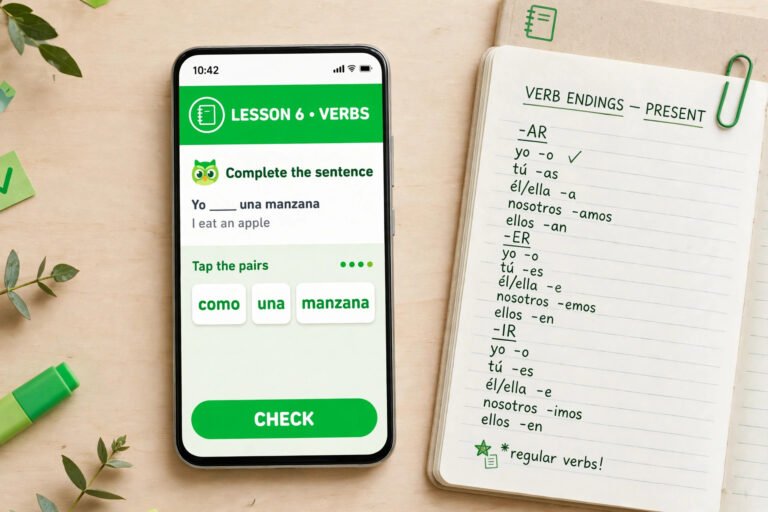
A typical lesson mixes several exercise types. You might match a new word to its picture, tap word tiles into the right order to build a sentence, translate a sentence from English into your new language, listen to a sentence and type what you hear, or speak a phrase into your microphone. Most lessons take about five minutes.
The app uses spaced repetition: it shows you words you are about to forget, just before you forget them. Get a word right and it appears less often; get it wrong and it comes back sooner. The app also adapts to you — if you keep missing the same pattern, you see more exercises on it.
What this means for you: the system is built for ten minutes a day, not two hours on a Sunday. Short, daily practice beats long, rare sessions. If you want to know whether Duolingo actually works as a learning method, the honest answer starts here: the method works best when the habit is daily.
What languages can you learn on Duolingo?
Duolingo offers courses in more than 40 languages, with over 250 courses in total, and the most popular are Spanish, French, German, Italian, Japanese, Korean, Chinese, and Portuguese.
The size of a course depends on the language. The nine biggest courses — English, Spanish, French, German, Italian, Portuguese, Japanese, Korean, and Chinese — now go up to a Duolingo Score of 129, which Duolingo equates to CEFR level B2, or upper-intermediate. That is the level where you can hold a real conversation about familiar topics and read straightforward articles. Smaller courses stop at a lower level, so check how far your language goes before you commit months to it.
English speakers have the widest choice, with courses in the big European and Asian languages, and smaller languages such as Welsh, Irish, Swahili, and Haitian Creole.
Duolingo has also grown beyond languages. The same app now offers courses in music, math, and chess, all using the same short-lesson format.
What this means for you: if you want to learn Spanish, French, or German, Duolingo gives you a long, well-built course. If you want a smaller language, it is still a good free start, but plan to add other resources sooner, because the course will run out sooner.
What is free on Duolingo, and what does Super cost?
The full course is free. Super costs about $12.99–$13.99 a month, or about $83.99–$119.99 a year in the US, and it removes ads and limits without adding new lessons.
Free users get the same lessons as paying users. You pay to remove friction, not to unlock a better course. Our full comparison of Super vs Free in November 2026 walks through every difference in detail.
| Feature | Free | Super |
|---|---|---|
| All language courses | Yes | Yes |
| Ads | Yes, between lessons | No ads |
| Mobile Energy limit | Yes, about 25 Energy a day | Unlimited Energy |
| Personalized practice | Limited | Yes |
| Streak Repair | Buy with gems | One free repair a month |
| Video Call with Lily | No | Yes, unlimited by end of 2026 |
| Price (US, November 2026) | Free | About $12.99–$13.99 a month |
Duolingo publishes no official price list, so the Super prices above are ranges seen in November 2026. Your own price can be different — check your screen before you pay, because prices vary by account, platform, and country.
There is also a Super Family plan for up to six people at about $119.99–$143.99 a year in the US. If you are weighing whether to pay, read our guide on whether Super is worth it for beginners first.
Duolingo Max was the premium tier above Super. Duolingo stopped selling new Max subscriptions in November 2026, and Video Call is moving into Super instead. Do not buy Max from any site that still lists it. Our review of Max explains what Max subscribers get instead.
What this means for you: start free. Use the app for two weeks, every day, before you even think about paying. If ads and the Energy limit are the only things stopping you from doing more, Super fixes exactly those two problems. If you are bored or stuck, Super will not fix that — a different course or a tutor will.
What is a streak, XP, gems, and Energy?
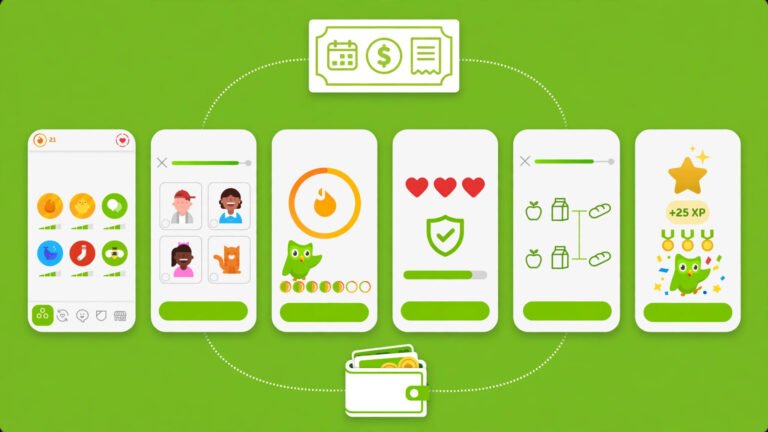
A streak is the number of days in a row you have finished at least one lesson. XP is the points you earn for lessons. Gems are the app’s currency. Energy is the fuel that limits free practice on mobile.
A streak is the flame icon at the top of your screen. Do one lesson today and your streak grows by one. Miss a day and it resets to zero, unless you have a Streak Freeze, an item you buy before you miss a day that saves your streak for one missed day. A streak measures showing up, not learning: a 1,000-day streak and a 1-day streak produce the same learning on any given day. Our guide to how a Duolingo streak works explains freezes, repairs, and what to do when a streak breaks.
XP, or experience points, is what you earn for finishing lessons, usually 10–20 XP per lesson. XP feeds the weekly leagues, where 30 learners are ranked by how much XP they earn that week. Leagues reward XP, not learning — you can earn huge XP by repeating easy lessons — so treat them as motivation, not as a measure of how good your language is.
Gems are the blue currency you earn from lessons, quests, and chests. You spend gems in the Shop on Streak Freezes, Streak Repairs, and XP Boosts. Gems are free to earn, and you never need to buy them to finish a course. Our guide to gems and hearts explained covers what each item costs.
Energy replaced Hearts on mobile in 2025. You start the day with about 25 Energy, and each question in a lesson costs 1 Energy, right or wrong. When Energy runs out, you wait for it to refill, watch an ad, or spend gems to keep going. On the web version, Duolingo still uses Hearts: you lose a Heart when you make a mistake. Our comparison of Energy vs Hearts explains the difference and how to stretch your free practice further.
What this means for you: learn these four words in your first week and the app stops being confusing. Streak = days in a row. XP = points for ranking. Gems = free currency for useful items. Energy = how much you can do for free on your phone each day.
What can Duolingo actually teach you — and what can it not do?
Duolingo can take a complete beginner to upper-intermediate level in its nine biggest courses, and it can build a daily habit that lasts for years. It cannot, on its own, make you fluent.
That limit belongs near the top of this guide, not buried at the bottom, because it is the question every beginner really asks.
First, what it does well. Duolingo is very good at the start. It teaches you the most common words, basic sentence patterns, and the sounds of a new language, in lessons short enough to finish on a bus. Its nine biggest courses now teach through B2 (Duolingo Score 129): you can travel, make small talk, and read simple news. The habit is the other strength — millions of people have kept a streak for a year or more.
Second, what it does less well. The core loop is recognition, not production. Most exercises ask you to pick the right answer from a list, not to produce a sentence from nothing. Speaking practice is shallow too: the speech recognition accepts a wide range of pronunciation, so it rarely tells you that you said a word wrong. Grammar is rarely explained, and the free Explain My Answer feature (free for all learners since January 2026) helps, but it is not a grammar course.
Third, what it cannot do at all. No course teaches C1 or C2, the advanced levels. Duolingo cannot give you a real conversation with a person who misunderstands you, changes the subject, or speaks at full speed with slang.
The fix is simple: keep Duolingo for the habit and the vocabulary, and add speaking sessions each week with a real person, a tutor, or a language exchange partner, plus reading and listening in your language. If you want the full verdict, read whether Duolingo is good and whether Duolingo works.
What this means for you: think of Duolingo as a starter, not a finish line — and a very good starter. The learners who get the most from it use it every day for the foundation and go elsewhere for conversation.
Who is Duolingo best for?
Duolingo is best for complete beginners, casual learners, and anyone who needs a daily habit. It is less useful for advanced learners and for people who need a language for a test or a job right now.
It suits you if you are starting from zero and want a free, structured way in. It suits you if you tried learning a language before and quit because the textbook was boring — the game format is genuinely good at getting you to come back tomorrow. It suits you if you have ten minutes a day and no more, because the lessons are built for exactly that. It also suits travelers who want the basics before a trip: greetings, ordering food, asking directions, and numbers.
It suits you less if you are already intermediate or advanced. The big courses now reach B2, but the path is long and slow, and the exercises stay simple even at higher levels. If you can already hold a conversation, your time is better spent reading, listening, and speaking with real people. It also suits you less if you need a language for a specific deadline, such as a job interview next month — Duolingo moves at its own pace.
Children use Duolingo too: the lessons are visual and the streak gives them a reason to practice. Duolingo for Schools, the classroom version, is closing on 31 July 2027 — our guide to Duolingo for Schools closing in 2027 explains what happens next.
What this means for you: match the app to your goal. If your goal is “start a language and stick with it for a year,” Duolingo is one of the best tools that exists. If your goal is “pass a test in eight weeks,” use it as a warm-up, not as the plan.
How do you start learning on Duolingo today?
Download the app, pick a language, take the placement test or start at the beginning, and finish one lesson today.
- Download Duolingo from the App Store or Google Play, or open duolingo.com in your browser. Create a free account with your email, Google, or Apple ID.
- Pick your language. Choose the language you want to learn. If you already know some of it, take the placement test — it skips the lessons you already know.
- Set a daily goal. The app asks how much time you want to study each day. Pick the smallest option, usually 5 minutes. You can raise it later; starting small is how the habit survives week two.
- Do your first lesson. Tap the first step on the path and finish it. That is your streak started: one day.
- Turn on reminders. Let the app remind you at a time you actually study — after breakfast, on your commute, or before bed.
- Add a friend. Learning with someone else makes the habit stick. A friend gives you someone to compete with in leagues and someone to share a streak with.
Then keep it simple for the first month. One lesson a day, every day, beats five lessons on Monday and none for the rest of the week. Do your review lessons when the app offers them. Use the Practice Hub, free for all learners since 18 February 2026, to review your mistakes and practice speaking and listening.
If your streak breaks, do not quit. The words you learned are still in your head, and a new streak starts with one lesson.
Bottom Line
Duolingo is a free, game-like app that teaches more than 40 languages through short daily lessons, and it is the best free way to start a language and build a habit that lasts. Super removes ads and the Energy limit but adds no new lessons, so start free and only pay if the limits are what hold you back. Duolingo alone will not make you fluent — pair it with real speaking and reading — but as a starter, it is very hard to beat.
Next: whether Duolingo actually works — the evidence on fluency · Super vs Free in November 2026 — every paid difference, priced · how a streak works — freezes, repairs, and broken streaks
Frequently Asked Questions
Yes. The full course in every language is free, including the lessons, the streak, and the Practice Hub. You will see ads, and on mobile your daily practice is limited by Energy, but you never have to pay to finish a course.
Yes — beginners are exactly who it is best for. It starts from zero, teaches the most common words first, and keeps lessons short enough to finish every day. It is less useful once you are already intermediate, when real conversation and reading matter more.
Not on its own. Its biggest courses reach upper-intermediate level (CEFR B2), and the exercises train recognition more than speaking. Pair Duolingo with real conversation, reading, and listening in your language to get to fluency.
More than 40 languages, with over 250 courses in total. Spanish, French, German, Italian, Japanese, Korean, Chinese, and Portuguese are the most popular, and the nine biggest courses go up to B2 level.
It depends on how much you study. Super removes ads and the Energy limit, which matters if you study every day for more than a few minutes. It adds no new lessons, so if you study five minutes a day, the free plan is enough.
Duolingo stopped selling new Max subscriptions in November 2026. Its main feature, Video Call, is moving into Super, with unlimited Video Call for all Super subscribers by the end of 2026. Max subscribers are being moved to Super Family plans.