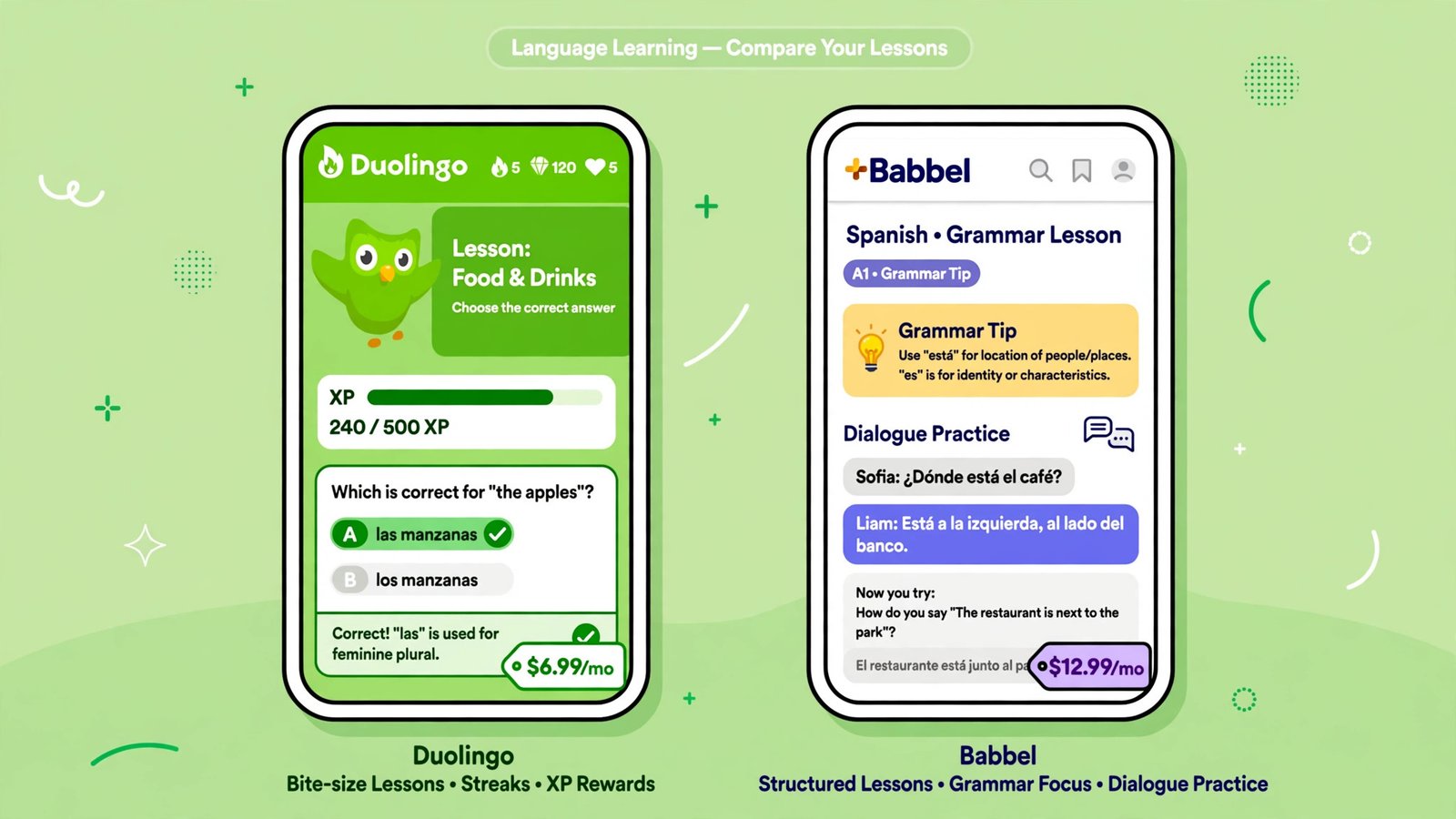
Duolingo vs Babbel: Which App Is Better in 2026?
Duolingo vs Babbel: Which App Is Better in 2026?
Duolingo is the better starting point: it is free, fun, and keeps you practicing every day. Babbel is the better classroom: it explains grammar in plain English and builds real conversations step by step. If you can only pay for one thing, start free on Duolingo — and add Babbel when you want explanations Duolingo never gives you.
This comparison covers price, lessons, grammar, speaking, and how far each app takes you, with prices checked against both apps’ own pricing pages in November 2026.
Takeaways
- Duolingo is free; Babbel is not. Every Duolingo lesson is free. Babbel only gives you the first lesson of each course for free, then charges $17.95 a month, or $107.40 a year ($8.95 a month) on the 12-month plan.
- Babbel teaches grammar; Duolingo mostly skips it. Babbel explains why a sentence works, in your own language. Duolingo expects you to absorb patterns from examples.
- Duolingo is better at keeping you coming back. Streaks, leagues, XP, and quests make daily practice a habit. Babbel has almost no gamification.
- Both apps stop at about the same level. Duolingo’s biggest courses now teach through B2. Babbel’s big courses reach B2 too. Neither app alone makes you fluent.
Which app is better overall, Duolingo or Babbel?
Neither app wins outright — they solve different problems, so the better app is the one that fixes your problem. Duolingo wins on price, habit, and fun. Babbel wins on teaching, grammar, and conversation. Most learners who quit Duolingo quit because they feel stuck translating sentences without understanding them. Most learners who quit Babbel quit because they stop opening it.
What this means for you: if you have never learned a language before, start with Duolingo. It costs nothing, and you will know within a month whether you enjoy the language. If you already know the basics and your complaint is “I can translate sentences but I cannot say anything myself,” Babbel is the upgrade that fixes that exact problem.
| Duolingo | Babbel | |
|---|---|---|
| Price | Free; Super about $12.99–$13.99 a month | $17.95 a month, or $107.40 a year |
| Free tier | Full course, ads and Energy limits | First lesson of each course only |
| Languages | 40+ | 14, all included in every plan |
| Lesson length | About 5–20 minutes, game-like | About 10–15 minutes, structured |
| Grammar | Patterns from examples, rarely explained | Explained in plain English |
| Speaking | Short scripted sentences (video calls are a Max feature) | Dialogues, speech recognition, AI practice |
| Highest level | B2 in the 9 biggest courses | B2 in the big courses, some reach C1 |
| Best for | Beginners, daily habit, free learning | Learners who want structure and grammar |
Choose Duolingo if you want to learn for free, you need a habit that sticks, or you are starting from zero. Choose Babbel if you will pay for clear grammar explanations and conversation practice. Use both if you want the habit and the teaching — that combination beats either app alone.
How much do Duolingo and Babbel cost?
Duolingo costs $0, and Babbel costs $107.40 a year on its cheapest plan. Every Duolingo lesson in every course is free. Babbel has no free tier beyond a trial taste: registration is free and the first lesson of every course is free to try, which Babbel says can add up to 80 free lessons across its courses, but full access needs a subscription.
Babbel’s US website prices, checked November 2026, are:
| Babbel plan | What you pay | Works out to |
|---|---|---|
| 1 month | $17.95 | $17.95 a month |
| 3 months | $45.75 up front | $15.25 a month |
| 6 months | $80.70 up front | $13.45 a month |
| 12 months | $107.40 up front | $8.95 a month |
| Lifetime | $299.99 once | No monthly cost after that |
Every Babbel plan includes all 14 languages, you pay for the whole period up front, and the subscription renews automatically unless you cancel it. Babbel also offers a money-back guarantee — check the length shown at checkout. On the free side, Duolingo gives you the whole course — the web version still uses hearts and has no Energy limit — while Babbel’s free access ends after the first lesson of each course.
Duolingo’s paid tier, Super, costs about $12.99–$13.99 a month or $83.99–$119.99 a year in the US (checked November 2026 — check your screen). But Super does not add lessons. It removes ads and the Energy limit, and adds extras like a monthly Streak Repair. Paying Babbel buys you the course itself, while paying Duolingo buys you convenience around a course that is already free.
What this means for you: a year of Babbel ($107.40) costs about the same as a year of Super. But they are not the same purchase. If your budget only stretches to one subscription, ask which problem you are paying to solve — and read the Super vs Free comparison before you pay Duolingo anything.
How do the lessons compare?
Duolingo lessons feel like a game; Babbel lessons feel like a class. Both teach vocabulary, listening, reading, and speaking, but the shape of a lesson is completely different, and the shape decides who sticks with it.
A Duolingo lesson is short — about 5–20 minutes — and built from quick exercises: match the word, pick the missing word, translate a sentence, say a sentence out loud. You earn XP for every exercise, and the streak, the league leaderboard, and the daily quests turn those exercises into a game you return to. The variety is the point: you rarely do the same exercise type twice in a row.
A Babbel lesson is longer — about 10–15 minutes — and built like a real lesson: new vocabulary first, then a grammar explanation, then a dialogue that uses both, then a review. Lessons are grouped into themed units, like ordering food or talking about films, so you learn words in the situation where you will actually use them. Babbel also has a review manager that uses spaced repetition to bring words back just before you forget them.
What this means for you: if you learn by doing and you get bored by explanations, Duolingo’s pace will suit you better. If you learn by understanding and you get frustrated by guessing, Babbel’s pace will suit you better. Try Babbel’s free first lessons before you pay, and try a week of Duolingo before you judge it.
Which app teaches grammar better?
Babbel teaches grammar better, and it is not close. This is Babbel’s biggest advantage, and it is the reason most people switch.
Babbel explains grammar in plain English, in your own language, at the moment you need it. When a German lesson introduces cases, it tells you what a case is, why the article changes, and how to spot it. When a Spanish lesson introduces the subjunctive, it explains when native speakers use it and when they do not. Every Babbel course is written for your native language — so an English speaker gets German noun gender explained from English, not from German.
Duolingo almost never explains grammar. It shows you patterns and expects you to absorb them from examples. Sometimes that works: after fifty examples of “el” and “la,” you start to feel which one fits. Often it does not: the subjunctive, German cases, and French verb agreement are hard to absorb from examples alone, and many learners stall exactly there. Duolingo has guidebooks for later lessons, and the free Explain My Answer feature can explain why an answer was wrong, but neither one is a grammar course. For a full look at the gap, read does Duolingo teach grammar.
What this means for you: if your goal is to understand the language, not just recognize sentences in it, Babbel is the only one of the two that explains things inside the lesson.
Which app is better for speaking?
Babbel is better for speaking practice, because its speaking is built around real dialogues — but neither app replaces talking to a real person. That honest limit applies to both, and it matters more than the gap between them.
Babbel’s speaking practice starts with dialogues: you hear a conversation, then you take one side of it, with speech recognition checking your pronunciation line by line. The dialogues are written around real situations — checking into a hotel, asking for directions, small talk at work — so the sentences you practice are sentences you might actually say. Babbel also has an AI speaking feature, Babbel Speak, in beta on mobile for French, German, Italian, and Mexican Spanish.
Duolingo’s speaking practice is thinner. Most speaking exercises ask you to repeat a single scripted sentence, and the speech recognition accepts a wide range of pronunciation, so it rarely corrects you. Video Call with Lily, Duolingo’s AI conversation feature, is a Max feature, not part of Super — still an AI conversation, not a human one. For practice ideas inside Duolingo, read how to practice speaking with Duolingo.
What this means for you: choose Babbel if speaking is your priority and you want the most realistic practice an app can give. Either way, plan to add real conversation once you can hold a simple exchange — speaking to a real person is the only practice that teaches you to think in the language instead of translating in your head.
How far can each app take you?
Both apps take you to about upper intermediate — B2 — in their biggest courses, and neither one takes you to fluency on its own. That is the honest ceiling.
Duolingo’s 9 biggest courses — including Spanish, French, and German — now teach through B2 (Duolingo Score 129), up from about A2 for most learners before April 2026. But no Duolingo course teaches C1 or C2, the advanced levels.
Babbel’s reach depends on the language. Its big courses — Spanish (Spain), French, German, and Italian — reach B2, and some extra content reaches C1. But the smaller courses stop much earlier: Danish, Norwegian, Indonesian, Polish, and Turkish top out around A2, and Russian around A1 to A2. Check the level of your language before you pay, because “Babbel goes to C1” is only true for a few courses.
The language list matters too. Duolingo teaches 40+ languages, including Welsh, Swahili, Hindi, Japanese, and Korean. Babbel teaches 14 — Spanish, French, German, Italian, Portuguese, Swedish, Dutch, Danish, Norwegian, Polish, Russian, Turkish, and Indonesian. If your language is not on Babbel’s list, the comparison is over before it starts. Babbel’s Spanish also comes in two versions, Spain Spanish and Mexican Spanish, so you can pick the one that matches where you will use it.
What this means for you: if your target language is Spanish, French, German, or Italian, either app can carry you to B2 — pick based on grammar and habit, not on the ceiling. And when you feel stuck around B1, read how to get past the intermediate plateau, because the plateau is where most learners quit.
What are the downsides of each app?
Duolingo’s downside is that it teaches without explaining. Babbel’s downside is that it costs money and gives you no reason to open it tomorrow. Each one is the reason people quit.
Duolingo trains recognition more than production, so you can translate sentences for months and still freeze when a real person speaks to you. It rarely explains grammar, so hard patterns stay mysterious. The free Energy limit caps mobile practice at about two to three lessons a day. And the streak measures showing up, not learning — a 1,000-day streak and a 1-day streak produce the same learning on any given day. None of that makes Duolingo useless. It makes it a starter, not a finish line. For the full honest picture, read whether Duolingo is good.
Babbel has no free tier, so you pay from the first month. There is almost no gamification: no streaks, no leagues, no XP races. That is a feature for some learners and a flaw for others, because without the game pulling you back, Babbel depends entirely on your own discipline. And its smaller-language courses are shallow, so a learner who picks Babbel for Danish or Russian may find the course ends just as they get going.
What this means for you: pick the downside you can live with. If you need a daily nudge, Duolingo’s gamification is not a gimmick — it is the feature that keeps you learning. If you need explanations, Babbel’s grammar is not a luxury — it is the feature that keeps you understanding.
Can you use Duolingo and Babbel together?
Yes — and for most learners, that is the best answer. The two apps cover each other’s weak spots almost exactly, and the combination costs less than most people expect.
Do Duolingo every day, first thing, for 15–20 minutes. That keeps the streak alive, builds vocabulary, and keeps the habit. Then do Babbel three or four times a week, for one lesson at a time, and treat it as your classroom: read the grammar explanations, say the dialogues out loud, and use the review manager to lock in the words. Duolingo keeps you consistent; Babbel keeps you understanding.
The cost of the combination is Babbel’s $107.40 a year, because Duolingo is free — about $8.95 a month. If you add Duolingo Super as well, the total rises to roughly $190–$227 a year, and at that point you should ask whether Super is adding anything Babbel does not already give you. For most learners in this combination, it is not.
Bottom Line
Duolingo is the better app to start with: free, fun, and built to keep you practicing every day. Babbel is the better app to grow with: it explains grammar, builds real conversations, and teaches you why sentences work. If you can only choose one, choose Duolingo while you are a beginner and Babbel when you want to understand the language — or use both, and let each one cover what the other misses.
Next: to decide whether paying Duolingo is worth it at all, read whether Super is worth it for beginners. If grammar is your reason for switching, see does Duolingo teach grammar. And if you want the wider field before you commit, browse the best Duolingo alternatives.
Frequently Asked Questions
Babbel is better for grammar, structured lessons, and conversation practice. Duolingo is better for price, daily habit, and fun. Neither app alone makes you fluent. The best setup for most learners is Duolingo daily for the habit, plus Babbel a few times a week for grammar and dialogues.
Babbel is worth it if you learn Spanish, French, German, or Italian, you want grammar explained in plain English, and you will use it several times a week. At $107.40 a year ($8.95 a month) it is fairly priced for a structured course. It is not worth it if you will not open it without streaks pushing you, or if your language is one of Babbel’s shallow courses.
No. Babbel has no free tier beyond a trial taste: registration is free and the first lesson of every course is free to try. Full access needs a subscription, starting at $17.95 a month or $107.40 a year. If your budget is zero, Duolingo is the free option — every lesson in every course is free.
Babbel is better for Spanish if you want grammar explanations and real dialogues, and it offers both Spain Spanish and Mexican Spanish. Duolingo is better if you want a free course with a daily habit, and its biggest courses now teach through B2. Many Spanish learners use both: Duolingo daily, Babbel a few times a week.
Babbel does more for speaking, with dialogues, speech recognition, and an AI speaking feature in beta for French, German, Italian, and Mexican Spanish. Duolingo’s speaking exercises are mostly repeating single sentences; Video Call with Lily is a Max feature. Neither app replaces talking to a real person.
Babbel teaches 14 languages, and every plan includes all of them. Duolingo teaches 40+ languages. Babbel’s deepest courses are Spanish, French, German, and Italian; its smaller courses, like Danish or Russian, stop at beginner level. Check your language’s depth before you pay.
Yes. Babbel subscriptions renew automatically, so cancel before the renewal date in your account settings to avoid being charged for the next period. If you cancel, you keep access until the end of the period you already paid for.


