Duolingo French Review: Is It Worth Your Time?
Duolingo French is a good way to learn the basics and build a daily French habit, and it can now carry you further than it used to — through B2 material. It will not make you fluent on its own. This review looks at the course in November 2026, after two rebuilds and the April 2026 extension to B2.
Takeaways
- Duolingo French is free, long, and genuinely useful — about 990 units, 8 sections, and more than 1,100 Stories, now teaching through CEFR B2.
- It is strongest at vocabulary, reading, and listening. Stories and DuoRadio carry the later sections further than the lesson loop alone.
- It is weakest at speaking and grammar explanation. You absorb patterns from examples; nobody explains the system to you.
- B2 is what the course teaches, not a level it certifies. Finishing the course does not prove B2 ability, and no Duolingo course teaches C1 or C2.
- Use it as your daily base, not your only tool. Add the French podcast, real reading, and real conversation to get past the intermediate wall.
How far does Duolingo French actually go?
Duolingo French now teaches content through CEFR B2, a Duolingo Score of 129 — further than any version of the course before April 2026.
CEFR is the Common European Framework of Reference for Languages, the scale most of Europe uses to describe language ability: A1 is beginner, B1 is intermediate, B2 is upper-intermediate, and C1 and C2 are advanced. A Duolingo Score is Duolingo’s own 0–160 measure of how much of a course you have covered. B2, or a Score of 129, is the top of that scale inside the app.
On 22 April 2026, Duolingo announced that nine of its most popular courses — French included — now teach advanced content through B2, free for most learners. Before that change, most learners in those courses could only reach A2, a Duolingo Score of 59.
What this means for you: if you start French today, the path is roughly twice as long as it was a year ago. The later sections cover news, culture, the subjunctive, and the passive voice — topics the old course never reached.
But keep one distinction in mind: B2 is what the course teaches, not a level it certifies. No independent test of Duolingo’s B2 label has been published, and no outside study has measured what learners actually reach on the new B2 content, because it only shipped in April 2026. Finishing Section 8 means you have worked through B2 material. It does not prove you can hold a B2 conversation or pass a B2 exam.
The course is organized into 8 sections of new content, plus Daily Refresh, a review section that sits after Section 8. Duolingo’s own CEFR mapping for the French course says finishing Section 3 means you have reached A1, finishing Section 4 means A2, finishing Section 6 means B1, and finishing Section 8 means B2.
| Section | CEFR level | What it covers |
|---|---|---|
| 1–2 | A0–A1 | Basics, greetings, food, family, present tense |
| 3 | A1 | Everyday routines, past tense begins |
| 4 | A2 | Travel, shopping, opinions, more past tenses |
| 5–6 | B1 | Work, health, media, conditional, future |
| 7–8 | B2 | News, culture, subjunctive, passive voice, idioms |
| Daily Refresh | Review | Mixed review of everything, updated daily |
A fan-run tracker that reads Duolingo’s own course data counted about 994 units in March 2026, after the course was rebuilt in September 2025 and again in February 2026. Treat the figure as “about 990 units” — Duolingo does not publish an official number, and it moves whenever the course is rebuilt.
What is inside the French course?
The French course is lessons plus three extras that matter more as you advance: Stories, DuoRadio, and Explain My Answer.
The core lesson loop is the same as every Duolingo course: short exercises that ask you to translate sentences in both directions, match words to pictures, type what you hear, and occasionally speak a sentence into the microphone. A typical lesson takes about five minutes.
Stories are short dialogues with comprehension questions. The French course has about 1,147 of them, according to the same fan-run tracker. Early Stories are simple exchanges — ordering coffee, meeting a neighbor. Later ones are longer, with jokes, misunderstandings, and cultural references. They are the best listening and reading practice inside the app, because they ask you to follow meaning across a whole conversation instead of one sentence at a time.
DuoRadio is a set of short podcast-style listening lessons built into the path. Early episodes mix English and French, then the French increases as the difficulty rises.
Explain My Answer is Duolingo’s AI feature that explains the grammar or vocabulary behind a single answer, right or wrong. Duolingo made it free for all learners on 1 January 2026, and it is available in French. Tap it after a mistake and it tells you why your answer was wrong in plain language. It is the closest Duolingo comes to a grammar teacher — but it explains one answer at a time.
French also has the Duolingo French Podcast, a free podcast of true stories told in intermediate French, with an English-speaking host who adds context. The storyteller speaks French and the host, Ngofeen Mputubwele, chimes in in English, so you can follow a real story even when you miss a sentence. Full transcripts are available at podcast.duolingo.com. Duolingo has sunset the podcast series, but all episodes remain available to stream. It is designed for learners around Unit 5 and above.
What does Duolingo French do well?
Duolingo French is best at three things: building a daily habit, teaching vocabulary in context, and giving you a huge amount of free listening and reading.
The habit is the product. The streak, the daily goal, the reminders, the leagues — all of it exists to get you to open the app every day. That sounds trivial, and it is the reason most people who start French on Duolingo are still doing it three months later, while most people who buy a textbook are not. A 600-day streak does not make you fluent, but 600 days of 10 minutes beats 600 minutes crammed into one weekend.
Vocabulary arrives in sentences, not word lists. You learn le pain while ordering bread, je voudrais while asking for something politely, il faut que while the subjunctive shows up in a real sentence. Words learned inside a sentence stick better than words memorized from a list, and Duolingo repeats them on a schedule so they come back just as you are about to forget them.
The listening and reading are far better than they used to be. The B2 extension added harder Stories and more DuoRadio episodes, with topics like news, culture, and abstract discussion. French pronunciation is famously hard to read — silent letters, liaisons — and hearing the same sentences spoken by native voices, then reading them, is how your ear learns to split the stream of sound into words.
And it costs nothing. Every lesson, Story, and DuoRadio episode is free, including the B2 material. Super removes ads and the Energy limit on mobile, but it does not add French lessons — free users get the same course.
Where does Duolingo French fall short?
Duolingo French is weakest at speaking, at explaining grammar, and at teaching you to produce French instead of recognizing it.
Speaking practice is shallow. The app asks you to read a sentence aloud into the microphone, and its speech recognition accepts a wide range of pronunciation. That is useful for getting comfortable making French sounds, but it is not a conversation. Nobody interrupts you, nobody misunderstands you, nobody asks a follow-up question. The course trains you to pick the right answer from a list far more than it trains you to build a sentence from nothing in real time.
Grammar is absorbed, not explained. French has gendered nouns, verb conjugations across many tenses, the subjunctive, and agreement rules that change word endings. Duolingo teaches these by showing you examples and letting you notice the pattern. Sometimes you do. Often you do not — you just memorize the forms without understanding why. Explain My Answer helps one mistake at a time, but no page in the app lays out the whole system in one place.
One French, unnamed. Duolingo teaches one version of French and does not say which one. It is standard metropolitan French. There is no Canadian French course, no Quebec vocabulary, and no African French content. If you are learning French for Montreal or Dakar, the course still works — the core language is the same — but the accent and some everyday words will differ.
The B2 label is untested. This is worth repeating, because it is the claim most likely to mislead: Duolingo says the course teaches through B2, and no independent study has confirmed what learners actually reach. The best-known peer-reviewed measurement of Duolingo outcomes, a 2021 study by Jiang and colleagues, tested beginning-level courses and measured reading and listening only — speaking was not assessed. Nobody has measured outcomes on the new B2 content.
Is Duolingo French good for beginners?
Yes — Duolingo French is one of the best free ways to start French from zero.
The first sections are gentle. You learn greetings, introductions, food, family, and numbers before anything complicated appears. Most answers are multiple choice or word-bank sentences, so you can make progress even when you are guessing. The listening exercises train your ear from day one — which matters, because French spelling and French sound are two different systems.
Two practical tips for the first month. Do the listening exercises with sound on, always — never mute the app and read only. Say the speaking exercises out loud even when the app would accept silence. Your mouth needs the practice as much as your eyes do.
The one thing beginners should know in advance: French pronunciation will feel unfair for the first few weeks. Letters go silent, eau sounds like o, and je ne sais pas collapses in fast speech. That is normal. It gets easier around Unit 3, when your ear starts to split the sound stream into words.
Is Duolingo French good for intermediate learners?
Yes, more so than it used to be — the B2 extension was built for intermediate learners, and it shows.
Before April 2026, intermediate learners hit a wall: the course ran out around A2, and the only thing left was review. Now Sections 6 to 8 carry you through B1 into B2, with longer Stories, DuoRadio episodes about news and culture, and grammar the old course never touched — the subjunctive, the passive voice, idioms, abstract discussion. If you finished the old course and quit, the new sections are worth coming back for.
That said, intermediate is where Duolingo’s limits bite hardest. At B1 and B2, what you need most is production — writing paragraphs, arguing a point, telling a story without a word bank — and Duolingo still mostly asks you to recognize the right answer. Use the course as the spine of your intermediate study, not the whole of it.
Duolingo French vs other ways to learn French
Duolingo is the best free starting point; it is not the best tool for speaking or for grammar, and it never claims to be.
| Option | Best for | Cost (checked November 2026) | The catch |
|---|---|---|---|
| Duolingo French | Daily habit, vocabulary, listening | Free; Super about $12.99–$13.99 a month | Almost no real speaking; grammar by example only |
| Babbel French | Grammar explained, structured lessons | Paid subscription; check your screen for the current price | Smaller course than Duolingo; less listening |
| Pimsleur French | Speaking and pronunciation from day one | Paid subscription; check your screen for the current price | Audio only; no reading or writing |
| italki tutor | Real conversation with a real person | Per-lesson pricing, varies by tutor | Costs money every week; no structured course |
Choose Duolingo if you want a free daily habit and a huge amount of content. Choose Babbel if you want grammar explained in writing as you go. Choose Pimsleur if speaking from lesson one is your priority. Choose a tutor if you need to talk to a real person before a trip, an exam, or a move. Most serious learners end up combining two: Duolingo for the daily habit plus one of the others for the skill Duolingo does not teach.
What should you use with Duolingo French?
Three additions turn Duolingo French from a good app into a complete routine: the French podcast, real reading, and real conversation.
The Duolingo French Podcast is free and intermediate, built for exactly this gap. Each episode tells a true story in French, with the host adding English context when the French gets hard. Listen to one episode a week, read the transcript at podcast.duolingo.com when you get lost, and listen again.
Real reading starts with graded readers — short books written for learners at your level — and grows into news, blogs, and novels. Reading is where vocabulary becomes yours: you meet the same words in new sentences, and you start to guess meaning from context instead of translating word by word.
Real conversation is the one thing no app can replace. One 30-minute conversation a week — a tutor on italki, a language exchange partner, a French-speaking friend — does more for your speaking than a month of app exercises. It has to be real: someone who does not understand you, asks you to repeat yourself, and waits while you find the word.
How much does Duolingo French cost?
The French course itself is free. Super costs about $12.99–$13.99 a month or about $83.99–$119.99 a year in the US, checked November 2026 — and your checkout screen is the binding price.
Duolingo publishes no official price list for its subscriptions, so those are ranges seen in November 2026. Your own price can be different — it varies by account, platform, and country, and Duolingo A/B-tests prices constantly. Check your screen before you pay.
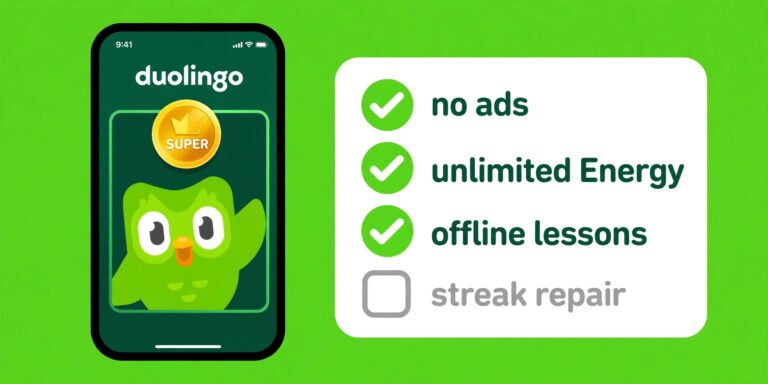
Super removes ads and the Energy limit on mobile, and it includes one Streak Repair a month. It does not add French lessons, and it does not teach more French — free users get the same course, the same Stories, and the same B2 material. Pay for Super if the ads and the Energy limit annoy you enough to slow you down. Do not pay for it expecting new French content, because there is none. Duolingo Max, the higher tier that added AI conversation features, is no longer sold — see our Duolingo Max review.
Bottom Line
Duolingo French is the best free way to start French and build a daily habit, and since April 2026 it genuinely carries you further — through B2 material, with more than 1,100 Stories and a free podcast. Duolingo has sunset the podcast series, but all episodes remain available to stream. It will not make you fluent alone. Use it every day, add the podcast and one real conversation a week, and it earns its place as the base of your French routine.
Next: Does Duolingo Work? — what the research actually says about learning with Duolingo · Duolingo German Review — the other deep course, and where it struggles differently · Best Way to Learn Spanish for Beginners — the same habit-first method for Spanish
Frequently Asked Questions
There is no fixed time — it depends on how many units you do a day. The course has about 990 units, so at 3 units a day it takes roughly a year, and at 1 unit a day it takes closer to three. Treat it as a daily habit, not a deadline.
No. Duolingo French teaches vocabulary, reading, and listening through B2 material, but it barely teaches speaking, and fluency means holding unscripted conversations with real people. Use Duolingo as your daily base, then add real conversation and real reading.
Yes. Every French lesson, Story, and DuoRadio episode is free, including the B2 material. Super removes ads and the Energy limit on mobile, but it adds no French lessons. The only thing you pay for is convenience, not content.
No. Duolingo teaches one version of French — standard metropolitan French. There is no Canadian French course, no Quebec vocabulary, and no African French content. The core language is the same, so the course still works if you are learning for Montreal or Dakar, but the accent and some everyday words will differ.
Yes, in the later sections. The subjunctive appears in Sections 7 and 8, inside sentences about wishes, doubts, and necessity — il faut que tu viennes, je veux qu’il parte. The course shows you the pattern through examples but does not explain the whole system in one place, so most learners need a grammar reference beside the app for this one.
No. B2 describes the material the course teaches, not a level it certifies. Finishing Section 8 does not give you a certificate, and no employer or university will accept a Duolingo Score as proof of French ability. If you need proof, take a recognized exam such as the DELF B2.