How to Prepare for the Duolingo English Test: A Full Guide
To prepare for the Duolingo English Test, take the free official practice test first, learn all 13 question types, and rehearse the test-day setup before you pay. The test costs $70 for one test or $118 for two, takes about an hour at home, and reports a score from 10 to 160 within 2 days.
Takeaways
- Take the free practice test first. It takes about 45 minutes, uses the same question types, and gives you an estimated score range.
- The test costs $70 for one test, or $118 for a two-test bundle (checked November 2026 — confirm at checkout).
- Scores run 10 to 160 in 5-point steps, with results in about 2 days and valid for 2 years.
- Practice scores usually run higher than real scores. If you need 120 on the real test, score at least 120 on the practice test.
- Check acceptance before you pay. The DET is not accepted for UK student visas, Australian student visas, or Canadian Express Entry.
What is the Duolingo English Test?
The Duolingo English Test (DET) is a one-hour English proficiency test you take at home, on your own computer, with no appointment. It is computer-adaptive, which means the questions get harder or easier based on your answers. It tests reading, writing, listening, and speaking, and it reports a single overall score from 10 to 160.
The DET is separate from the Duolingo language-learning app. You do not need a Duolingo account or a streak to take it. You register at englishtest.duolingo.com, buy a test, and take it whenever you are ready — 24 hours a day, 7 days a week.
It is an admissions test: universities use it to judge whether your English is strong enough for their programs. Duolingo says more than 6,500 programs accept it, including all eight Ivy League universities. But acceptance is decided by each institution, not by Duolingo.
What this means for you: if a university on your list asks for an English score, the DET is usually the cheapest and fastest option — $70 and results in 2 days, against several hundred dollars for IELTS or TOEFL. But cheap only helps if your university accepts it — check its admissions page before you pay.
What does the DET cost?
One test costs $70. A two-test bundle costs $118, saving $22. These are the prices shown on Duolingo’s official test site, checked November 2026. Confirm the price at checkout — it is shown in your account before you pay, and local tax may be added.
| What you buy | Price (USD) | What you get |
|---|---|---|
| Single test | $70 | One test credit, up to 3 attempts to complete and upload it |
| Two-test bundle | $118 | Two test credits, saving $22 against two singles |
| Faster Results (add-on) | $39 (typically — confirm at checkout) | Results faster than the standard 2 days |
A few things about the price that catch first-time test takers out:
One purchase is one credit, not one sitting. A credit gives you up to three attempts to complete and upload the test within 21 days of purchase. If your internet drops mid-test, try again on the same credit — but if you use up all three attempts without a completed upload, the credit is gone.
Sending scores is free. Once you have a certified result, you can send it to as many institutions as you like at no extra cost. There is no per-university fee, unlike tests that charge for each score report.
Faster Results typically costs $39 extra, according to Duolingo’s own Global Partner Network FAQ. It cuts the result wait to about 12 hours. The exact add-on price is shown at checkout, so confirm it there before you pay.
What this means for you: buy one test first, not the bundle. Take the practice test, see your estimated range, and only buy the bundle if you think you will want a second attempt.
What does the DET cover? All 13 question types
The DET has 13 question types, split across reading, writing, listening, and speaking. The test is adaptive, so the exact number of each type varies from one test to the next — the table below gives Duolingo’s official ranges. The questions get harder or easier depending on your answers, so no two test takers see the same test.
| Question type | What you do | How many | Skill |
|---|---|---|---|
| Read and Select | Decide whether each word on screen is a real English word or a convincing fake | 15–18 | Reading |
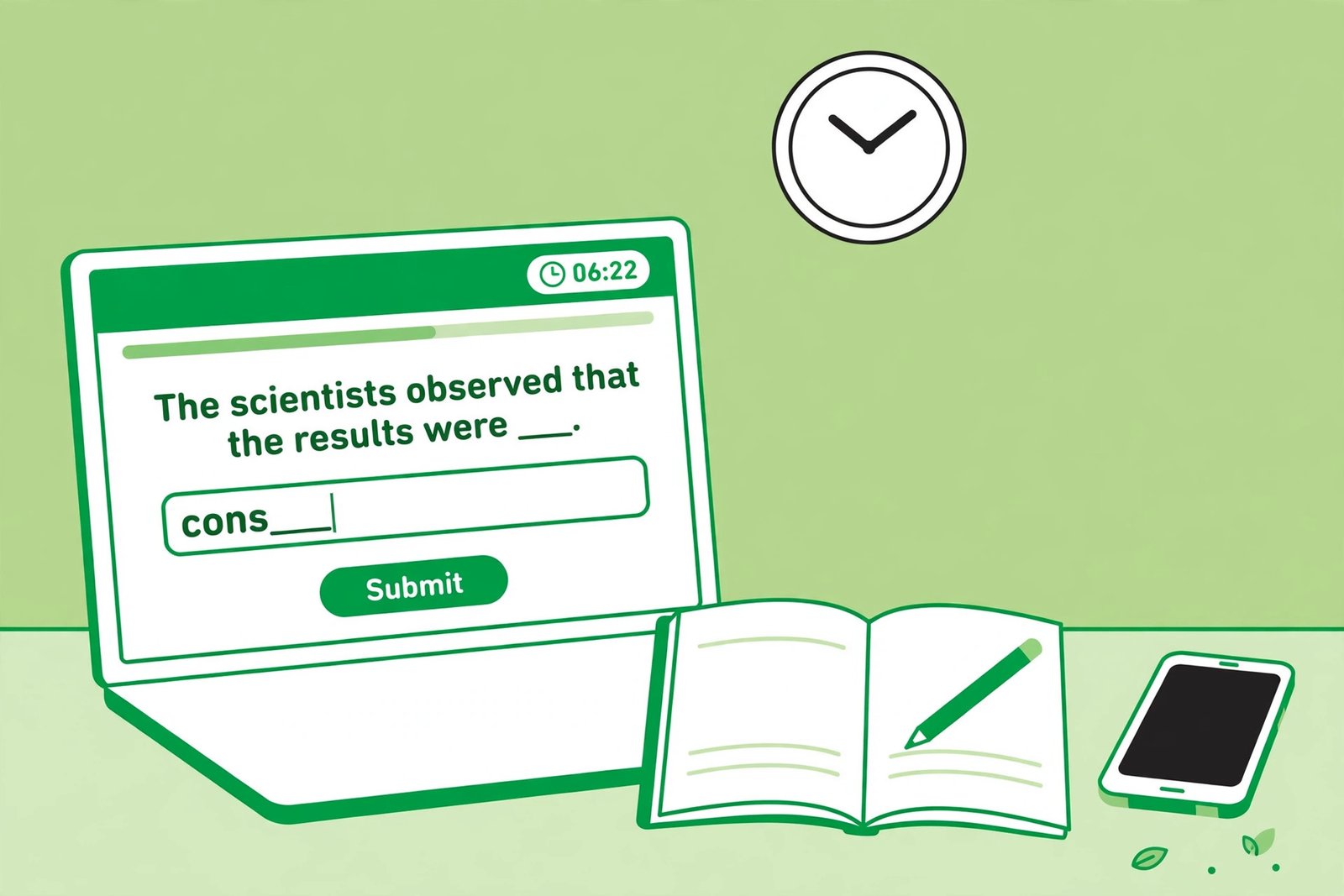
| Fill in the Blanks | Type the missing letters to complete words in a passage | 6–9 | Reading |
| Read and Complete | Fill in missing letters in a paragraph | 3–6 | Reading |
| Listen and Type | Type a sentence you hear | 6–9 | Listening |
| Interactive Reading | Answer several questions about a passage | 2 sets of 6 | Reading |
| Interactive Listening | Answer questions about a conversation | 2 sets of 8–10 | Listening |
| Interactive Writing | Write in response to a prompt, in two stages | 1 set | Writing |
| Write About the Photo | Describe an image in writing | 3 | Writing |
| Read, Then Speak | Read a passage, then speak about it | 1 | Speaking |
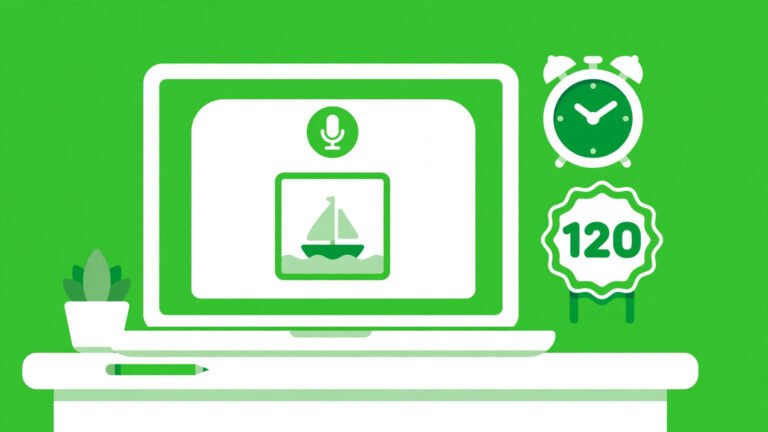
| Speak About the Photo | Speak about a photo for up to 90 seconds | 1 | Speaking |
| Interactive Speaking | Hold a simulated conversation with an on-screen avatar | 1 set of 6–8 | Speaking |
| Writing Sample | Write about a topic for 5 minutes (unscored, shared with institutions) | 1 | Writing |
| Speaking Sample | Speak about a topic for 1–3 minutes (unscored, shared with institutions) | 1 | Speaking |
Each Interactive Listening set opens with a Listen and Complete stage, then Listen and Respond questions and a written summary.
The test runs about an hour in total: about 5 minutes of setup and ID check, about 45 minutes of scored questions, and about 10 minutes of writing and speaking samples. Question types appear in mixed order in the adaptive section; the writing and speaking samples come at the end.
One thing changed recently: on 1 July 2025, Duolingo replaced “Listen, Then Speak” with Interactive Speaking — a simulated conversation of 6 to 8 questions, 35 seconds each — and removed Read Aloud. A guide written before July 2025 has an out-of-date question list.
What this means for you: the short, fast items — Read and Select, Fill in the Blanks, Read and Complete, Listen and Type — reward spelling and vocabulary under time pressure. They are the easiest points to gain quickly, because they test knowledge you already have rather than a skill you must build. Drill them first.
How is the DET scored?
You get an overall score from 10 to 160, in 5-point steps. Your overall score is the average of four individual subscores — Reading, Writing, Listening, and Speaking — rounded up to the next score ending in 0 or 5. You also get four integrated subscores: Literacy, Comprehension, Conversation, and Production. All scores use the same 10–160 scale.
| Score range | What it means | Rough CEFR level |
|---|---|---|
| 10–55 | Can understand very basic English words and phrases | A1–A2 |
| 60–85 | Can fulfill basic social and academic needs | B1 |
| 90–115 | Can fulfill most communication needs, though with some mistakes | B2 |
| 120–135 | Can fulfill most communication needs with ease | C1 |
| 140–160 | Can understand a wide range of demanding written and spoken language | C2 |
Two warnings about scores. First, Duolingo labels its CEFR mapping provisional, and institutions set their own bar — most ask for 105 to 120. Check the exact requirement on your university’s admissions page.
Second, practice test scores usually run higher than real test scores. Learners consistently report scoring lower on the real test. The rule: if you need 120 on the real test, score at least 120 — preferably 125 — on the practice test before you pay.
What this means for you: your target score is not the number you hope for. It is the number your university requires, plus a 5-point cushion. Aim for the cushion.
What do you need on test day?
You need a quiet room, a Windows or Mac computer with a camera and microphone, a government ID, and a smartphone as a second camera. The test is recorded and reviewed, and the setup is strict. Most “not certified” results come from setup mistakes, not from English mistakes.
Here is the setup, step by step:
1. A quiet, private, well-lit room. You must be alone in the room for the whole test. No one else may enter. The room must be bright enough for the camera to see your face clearly. Close the door.
2. A Windows or Mac computer. The test runs in Duolingo’s desktop app, which you install before test day. Chromebooks, tablets, and phones cannot run it — and the computer you practice on must be the computer you test on.
3. A front-facing camera and microphone. Built-in laptop cameras and microphones are fine. Test both before test day. If the app cannot see or hear you, the test cannot be certified.
4. A smartphone as a second camera. Since September 2025, Duolingo requires a second camera — your phone, set up so it captures your screen and keyboard for the whole session. Practice placing the phone before test day so you are not solving it under pressure.
5. A government-issued photo ID. A passport, driver’s license, or national ID card. You show it to the camera during setup. The name on the ID must match the name on your DET account exactly.
6. Nothing else on the desk. No headphones, no second monitor, no notes, no phone except the second camera, no books. Keep your eyes on the screen — looking away repeatedly, speaking to someone, or leaving the frame can get your result marked “not certified”, which means no score and no refund.
What this means for you: rehearse the setup at least once before you pay. Install the app, test the camera and microphone, place the phone, and run the practice test in the same room, at the same desk, with the same lighting.
How to prepare: a 4-week plan
Most test takers need 2 to 4 weeks of focused practice if their English is already near the level they need — longer if it is not. The plan below assumes 4 weeks. If you have less time, cut the vocabulary work, not the practice tests.
Week 1: Learn the test. Take the free official practice test on your first day. It takes about 45 minutes, uses the same question types and adaptive format as the real test, and ends with an estimated score range. Then read Duolingo’s free Question Guide (2026), which explains every question type with timing and tips.
Week 2: Drill the fast items. Read and Select, Fill in the Blanks, Read and Complete, and Listen and Type reward spelling and vocabulary under time pressure. Practice them daily in short sessions — 20 minutes a day beats a three-hour block — and read English every day.
Week 3: Rehearse speaking and writing to a timer. Record yourself describing photos and answering everyday questions, then listen back for long pauses and repeated words. Fill the full speaking time with clear, organized speech. For writing, practice typing — accuracy matters as much as speed.
Week 4: Full rehearsal. Take the practice test again in full test conditions — same room, same computer, phone as second camera, no interruptions. If your estimated range is at or above your target plus 5 points, book the real test. If it is below, drill for another week first.
What this means for you: the practice test is free and unlimited. There is no reason to pay $70 before you know your estimated range. Take it first, take it again, and only book the real test when the range says you are ready.
Will my university accept the DET?
Check before you pay — the DET is not accepted everywhere. Duolingo says more than 6,500 programs accept it, and that includes all eight Ivy League universities and all 15 of Canada’s U15 research universities. But acceptance is decided by each institution, and three hard limits apply.
The DET is not accepted for UK student visas (UKVI). A UK visa needs a Secure English Language Test from an approved provider. The DET does not qualify.
The DET is not accepted for Australian student visas. Australian universities may accept it for admission, but the visa itself needs a different test.
The DET is not accepted for Canadian Express Entry or permanent residence. A Canadian university may accept it for admission and support a study permit — but the test itself is not an immigration document.
The rule is simple: the DET is an admissions test, not a visa test. If your plan involves a visa, check the visa rules first, then check the university. Both must accept the test you take.
What this means for you: before you spend $70, open your university’s admissions page and search for “Duolingo English Test”. If the page lists a minimum score, write it down — that number is your target. If the page does not mention the DET, email the admissions office and ask. Do not guess.
What the DET can’t do
The DET cannot prove your English is good enough for a visa, and it cannot guarantee a university will take you. A good score is a ticket to be considered, not an admission letter. Universities weigh grades, essays, recommendations, and interviews alongside the score.
It also cannot measure everything. It is a one-hour test taken alone in a room — it measures reading, writing, listening, and speaking under test conditions, not how you will cope in a seminar. Treat the score as a standardized snapshot: useful for admissions, limited as a picture of your real English.
That does not make the DET a bad test. For what it is — cheap, fast, available at home, accepted by thousands of programs — it is the most practical English test most test takers will ever take. Use it for the job it does.
Bottom Line
Prepare for the DET by taking the free practice test first, learning all 13 question types, and rehearsing the test-day setup before you pay $70. Aim for your university’s required score plus 5 points on the practice test, check acceptance before you buy, and give yourself 2 to 4 weeks of focused practice.
Next: if you are worried about the rules, read what counts as cheating on the Duolingo English Test — it explains what gets a result marked “not certified” and how to avoid it. For the test-day checklist and what to do if your result is not certified, see Duolingo’s own Help Center at englishtest.duolingo.com.
Frequently Asked Questions
Two years from the test date. After 2 years, the score expires and you must take the test again. Universities will not accept an expired score, so time your test to fall within the application window.
$70 for one test, or $118 for a two-test bundle (checked November 2026 — confirm at checkout). One purchase gives you one credit with up to three attempts to complete and upload the test, and you must take it within 21 days. Sending scores to institutions is free.
It depends on your English level and your target score. The test is adaptive, so the questions adjust to your level — strong test takers face harder questions. Most universities ask for 105 to 120. If your English is already near that level, 2 to 4 weeks of focused preparation is usually enough.
It depends on the institution. Most universities that accept the DET ask for 105 to 120, and competitive programs ask for 125 or higher. Scores run 10 to 160 in 5-point steps. Check your university’s admissions page for its exact minimum, then aim 5 points above it on the practice test.
The most common reasons are setup problems: someone entered the room, you looked away from the screen repeatedly, the second camera was missing or misplaced, or your ID did not match your account. A “not certified” result means no score and no refund. Rehearse the setup before test day and follow the rules exactly.
No. You need a Windows or Mac computer to run the test app. Your phone is used only as the second camera, capturing your screen and keyboard for the whole session. Chromebooks, tablets, and phones cannot run the test itself.
You can buy up to 3 tests in any 30-day period, and you must wait for the result of one test before starting another. Each purchase is a separate credit with up to 3 attempts to complete and upload it within 21 days.



One Comment