Is Duolingo Video Call Coming to Super? Yes — Soon
Yes. Duolingo confirmed on 3 November 2026 that Video Call is coming to Super — new Super subscribers already get unlimited Video Call, and all Super subscribers will have it by the end of 2026. You do not need the Max plan to use it anymore.
This article covers the timeline, what Video Call does, and what is unconfirmed.
Takeaways
- Video Call is coming to Super — confirmed. Duolingo said so in its Q3 2026 shareholder letter on 3 November 2026.
- New Super subscribers already get unlimited Video Call. All Super subscribers get it by the end of 2026.
- Max is being discontinued in November 2026 because its best feature is moving to Super.
- Roleplay is NOT confirmed for Super. Duolingo’s letter names Video Call only.
- Video Call is mobile-only and works in selected courses — check your app to see if it has arrived for you.
Is Video Call coming to Super?
Yes. Duolingo confirmed it in writing on 3 November 2026, in its Q3 2026 shareholder letter.
The letter says: “Last quarter we began giving unlimited access to Video Call to new Super subscribers, and we’re on track to make it available to all Super subscribers by the end of this year.” That is about as clear as a company announcement gets. The rollout started in mid-2026 for new subscribers, and the company says the rest of Super will follow before the year ends.
This is not a rumor from a forum or a leak from a beta tester. It is a statement in a document filed with the US Securities and Exchange Commission, from Duolingo’s own CEO. When a public company puts a date in a shareholder letter, it is a commitment to investors as well as to users.
What this means for you: if you already pay for Super and you do not see Video Call yet, it is coming — the company says by the end of 2026. If you are thinking of subscribing, a new Super subscription already includes unlimited Video Call. Either way, there is no need to buy Max for this feature anymore.
When will I get Video Call on Super?
If you are a new Super subscriber, you already have it. If you are an existing Super subscriber, Duolingo says you will have it by the end of 2026.
The rollout has happened in stages, and the dates matter if you are waiting:
| When | What happened |
|---|---|
| September 2024 | Video Call with Lily launches for Max subscribers |
| January 2026 | Video Call with Falstaff, a beginner mode, is announced |
| Mid-2026 | Unlimited Video Call starts reaching new Super subscribers |
| 3 November 2026 | Duolingo confirms the move in its Q3 shareholder letter |
| End of 2026 | Unlimited Video Call reaches all Super subscribers, Duolingo says |
Duolingo rolls features out gradually — a technique called A/B testing — so two Super subscribers can have different features on the same day. Your account may get Video Call weeks before or after your friend’s. That is normal for this app, and it is not a bug.
How to check if you have Video Call
Open the Duolingo app on your phone and look for the Video Call entry point. In most versions it appears as a character icon or a call option on the home screen or inside your course. Tap it and you will see Lily, the AI character, ready to talk.
If you do not see it yet: first, update the app to the latest version from the App Store or Google Play. Then check that you are signed in to the account with the Super subscription — Video Call is tied to the subscription, not the device. Then wait: Duolingo says the rollout finishes by the end of 2026, and there is no button to speed it up. If the year ends and you still do not have it, contact Duolingo support through the app’s Help section and ask about Video Call availability for your account.
What this means for you: the wait is measured in weeks, not months. If your Super subscription renews in December 2026, check the app after the renewal — that is a common point for a new feature to appear.
What is Video Call, exactly?
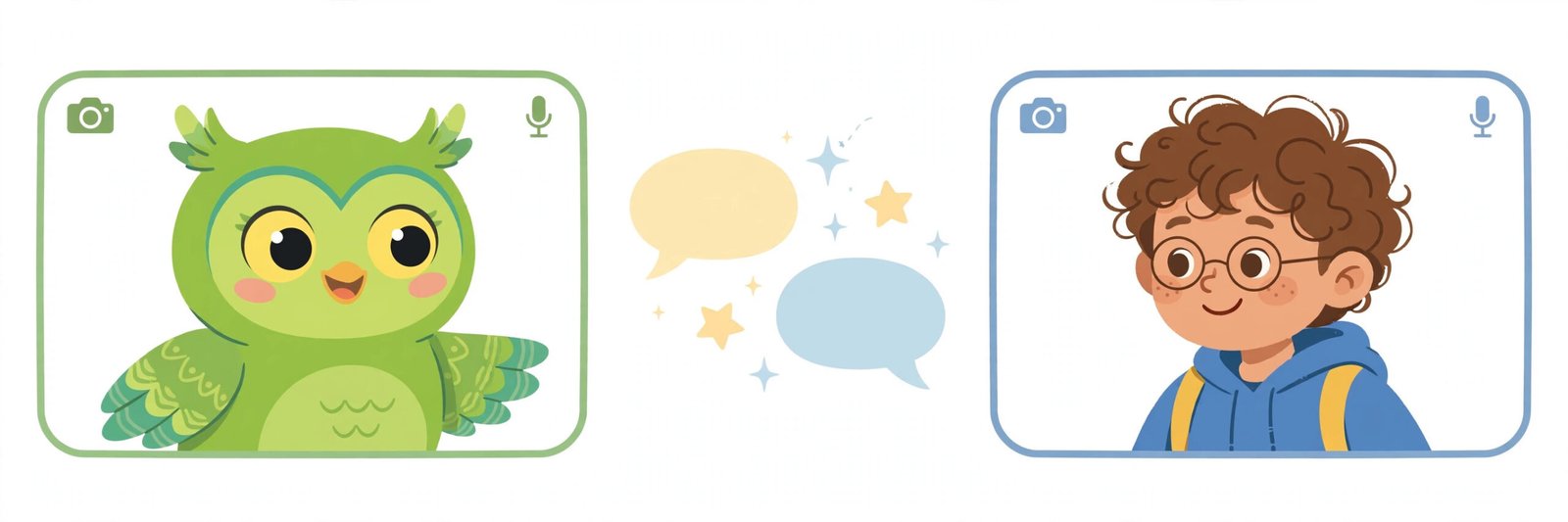
Video Call is a spoken conversation with Lily, an AI character, in the language you are learning — and it remembers what you talked about last time.
You tap to start a call, and Lily talks to you. You answer out loud, in the language you are learning. The conversation is open-ended: it is not a quiz with right and wrong answers, and it is not a scripted dialogue. Lily adapts to your level, so a beginner gets short, simple questions and an advanced learner gets a faster, more natural conversation. Calls last about a minute early in a course and up to three minutes as you advance, according to Duolingo’s Help Center.
Lily remembers details from earlier calls and brings them up again later — if you told her you like cooking, she may ask about it next time. After the call you get a transcript, so you can read what you said and what she said.
Video Call with Falstaff is the beginner version, announced on 14 January 2026. Falstaff is a multilingual bear who asks level-appropriate questions, suggests phrases you can use, and gives real-time feedback in your own language. If Lily feels too fast, Falstaff is the gentler start.
Video Call works in selected courses. For English speakers, that means Spanish, French, German, Italian, and Portuguese, plus Video Call in Japanese, Korean, and Chinese. If your course is not on that list, Video Call will not appear for you even with Super — check your screen to see what your course offers.
What this means for you: Video Call is the closest Duolingo has come to a real conversation. It is not a human tutor, and it will not correct you the way a teacher would — but it is the only feature in the app where you speak freely instead of picking from a list of answers.
Why is Duolingo moving Video Call to Super?
Because it got cheap — and because ten times more people pay for Super than for Max.
When Video Call launched, each call cost Duolingo about $0.30 to run in AI computing costs. That is why it sat behind the most expensive plan: the company needed the Max price to cover it. By November 2026, the cost had fallen to well under $0.01 per call, mainly because Duolingo moved to open-weight AI models instead of paying for the most expensive commercial ones.
At that price, keeping Video Call locked to Max made no sense. Max is a small tier — Duolingo says it is a single-digit percentage of paid subscribers and bookings. Super has roughly ten times as many subscribers. Moving Video Call to Super gives the feature to about ten times as many people, and Duolingo’s own testing found that offering Video Call in Super trials made people more likely to subscribe.
The numbers back up the move. Duolingo says the average number of words spoken per user in Video Call has roughly doubled over the past year, and users who tried Video Call during a free trial were more likely to subscribe. The feature works better when more people can use it.
What this means for you: the price of AI fell, and you are the beneficiary. A feature that cost $0.30 a call — and needed a roughly $29.99-a-month Max plan to pay for it (checked November 2026) — now costs less than a cent, so it comes with the roughly $12.99–$13.99-a-month Super plan instead. Check your screen for your exact price.
What happens to Duolingo Max?
Duolingo Max is being discontinued. New Max subscriptions stopped being sold in November 2026.
Max launched in March 2023 as a top tier above Super, built around AI features: Roleplay and Explain My Answer, with Video Call added in September 2024. Over 2026, its exclusives disappeared one by one. Explain My Answer became free for all learners on 1 January 2026. Video Call started moving to Super in mid-2026. With its best feature gone, Duolingo decided to shut the tier down.
Here is what happens to Max subscribers:
| Your plan | What happens |
|---|---|
| Max Individual | Moved to a Super Family plan at the same price |
| Max Family | Duolingo will decide on options in 2027 |
| Thinking of buying Max | You cannot — new sales stopped in November 2026 |
If you are on Max Individual, the move is designed to be painless: same price, a Super Family plan, and Video Call included. The main thing you lose is Roleplay, which has not been confirmed for Super. If you are on a Max Family plan, Duolingo has said it will announce your options in 2027 — check your email and the app for updates, and do not cancel anything until you have heard from Duolingo.
Do not buy Max from any site that still lists it. There is no new Max subscription to buy. Any website, app store listing, or third-party seller offering Max in late 2026 is out of date or misleading.
What this means for you: if you wanted Max for Video Call, buy Super instead — it is cheaper and it now includes the feature. If you already have Max, do nothing: Duolingo is moving you, and your price stays the same.
Is Roleplay coming to Super too?
Not confirmed. Duolingo’s Q3 2026 letter names Video Call only — it says nothing about Roleplay moving to Super.
Roleplay is the other AI conversation feature from Max. In Roleplay, you practice a scenario with a Duolingo character — ordering food, shopping for furniture, checking into a hotel — and the character responds in the language you are learning. It is available to English speakers learning French, Spanish, German, Portuguese, and Italian.
The silence matters. Duolingo had every reason to mention Roleplay in the same letter if it were moving, because the letter explains why Max is being shut down. Instead, the letter ties the shutdown to Video Call alone. That suggests Roleplay’s future is undecided — it may stay as a Max legacy feature for existing subscribers, it may move to Super later, or it may be retired.
This is the one honest gap in the story. If Roleplay is the feature you actually use, do not assume it is coming to Super. Keep your Max subscription until Duolingo says what happens to it, and watch for an announcement in 2027.
What this means for you: Video Call is the safe bet — confirmed, dated, rolling out. Roleplay is a question mark. If you are choosing a plan today, choose it for Video Call, not for Roleplay.
Is Video Call actually good for speaking?
It is the best speaking practice Duolingo has ever offered — and it is still not a real conversation.
The honest version has two sides. On the plus side, Video Call makes you speak. Most Duolingo lessons are multiple-choice and tile-matching: you recognize the right answer, you do not produce a sentence. A Video Call forces you to form sentences out loud, in real time, with no options to pick from. Duolingo’s own data says the average words spoken per user in Video Call has roughly doubled over the past year — people are talking more, not less.
On the minus side, Lily is patient in a way no human is. She will not interrupt you, she will not misunderstand you in the way a real person would, and she will not push back when you say something odd. Her corrections are gentle and her memory is a party trick, not a relationship. A three-minute call is a warm-up, not a conversation.
The right way to use it is as a stepping stone. Do a Video Call once or twice a week to get comfortable speaking out loud, then take that comfort into a real conversation — a tutor, a language exchange, or a trip. Video Call lowers the fear of speaking; it does not replace the person you eventually need to speak to.
What this means for you: if you have never spoken your language out loud, Video Call is the easiest first step you will find — no scheduling, no stranger, no embarrassment. If you already speak comfortably, it will feel limited quickly, and your time is better spent with a human.
Bottom Line
Video Call is coming to Super — Duolingo confirmed it on 3 November 2026, new Super subscribers already have unlimited access, and all Super subscribers will have it by the end of 2026. Max is being discontinued because its best feature no longer needs the most expensive plan. The only open question is Roleplay, which Duolingo has not confirmed for Super. If speaking practice is what you want, Super is now the plan to buy.
Next: What happens as Max is discontinued · Super vs Free: what you actually get · Explain My Answer is free now
Frequently Asked Questions
Yes. Duolingo confirmed in its Q3 2026 shareholder letter (3 November 2026) that unlimited Video Call is coming to all Super subscribers by the end of 2026. New Super subscribers already get it.
Yes. Video Call is a paid feature — it comes with Super (and previously with Max). Free users do not get Video Call, but they do get Speaking Adventures, a free AI speaking lesson type.
For English speakers: Spanish, French, German, Italian, and Portuguese, plus Japanese, Korean, and Chinese. If your course is not on that list, Video Call will not appear. Check your app to see what your course offers.
About a minute early in a course and up to three minutes as you advance, according to Duolingo’s Help Center. Calls are short by design — they are practice, not a lesson.
Not confirmed. Duolingo’s announcement names Video Call only. Roleplay’s future has not been announced — if you use Roleplay, keep your Max plan until Duolingo says what happens to it.
New Max sales stopped in November 2026. Individual Max subscribers move to a Super Family plan at the same price, with Video Call included. Max Family plan holders will hear about their options in 2027.