Duolingo Statistics 2026: Users, Revenue & Growth
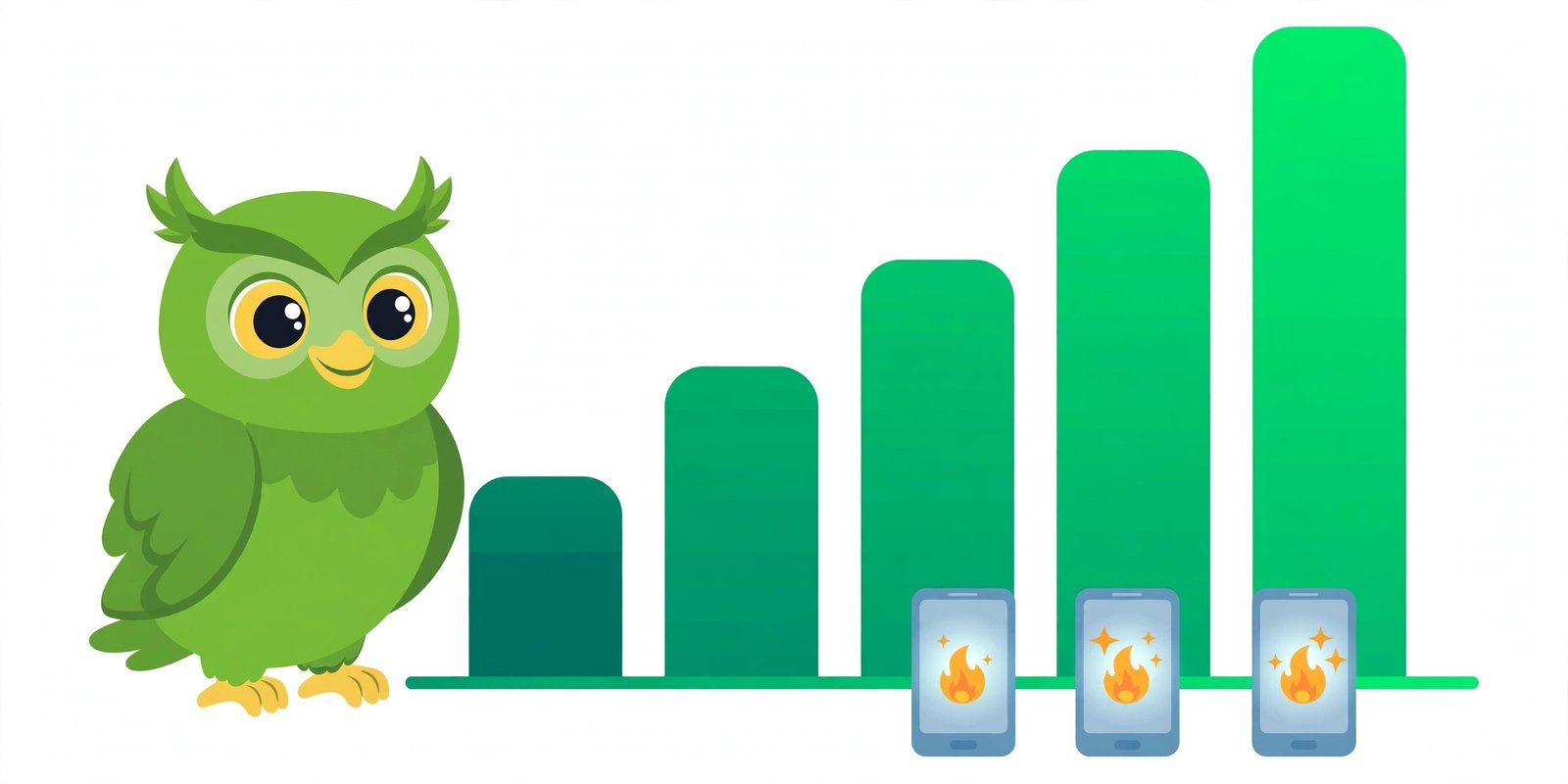
Duolingo averaged 64.9 million daily users and 153.1 million monthly users in the third quarter of 2026, with 13.1 million paid subscribers — all figures from Duolingo’s own shareholder letter of 3 November 2026. Daily users grew 29% in a year, a second straight quarter of acceleration.
Takeaways
- 64.9 million people open Duolingo every day (Q3 2026 average), and 153.1 million use it at least once a month.
- 13.1 million people pay for a subscription — about 1 in 5 daily users.
- Revenue was $309 million in Q3 2026, up 14% in a year; subscriptions bring in about 87% of it.
- Duolingo’s goal is 100 million daily users by 2028. At 29% growth, it is ahead of the pace it needs.
- Chess is the surprise hit: 10 million people play Duolingo Chess every day, and the company has not yet charged for it.
How many people use Duolingo in 2026?
Duolingo averaged 64.9 million daily active users and 153.1 million monthly active users in the third quarter of 2026, the three months ending 30 September 2026.
A daily active user, or DAU, is one person who opens the Duolingo app or the learning section of the website on a given day. A monthly active user, or MAU, is one person who uses it at least once in a month. Duolingo reports both as averages across the quarter, and both come from its shareholder letter of 3 November 2026, filed with the US Securities and Exchange Commission.
The daily number is the one Duolingo itself watches most closely. It tells the company how many people have made the app a daily habit, not just a download. The monthly number is broader: it includes the weekend learner, the person who opens the app twice a month, and the learner who comes back after a break.
What this means for you: about 42 out of every 100 monthly users open the app every day, so the leagues and leaderboards you see are full of people who show up as often as you do.
Duolingo’s user growth through 2026
Daily user growth sped up in every quarter of 2026 so far. That matters because growth had been slowing through 2025, and Duolingo changed its whole strategy in February 2026 to fix it — putting user growth ahead of short-term revenue.
| Quarter | Daily users | Monthly users | Paid subscribers |
|---|---|---|---|
| Q1 2026 | 56.5 million | 137.8 million | 12.5 million |
| Q2 2026 | 58.7 million | 140.6 million | 12.7 million |
| Q3 2026 | 64.9 million | 153.1 million | 13.1 million |
Growth rates tell the same story in a different way. Daily users grew 21% year over year in Q1, 23% in Q2, and 29% in Q3. Monthly users grew 13% in Q3. The Q3 jump — 6.2 million more daily users than Q2 — is the biggest single-quarter gain in the table above.
Duolingo says the growth came mostly from existing users coming back more often, not just from new downloads. Its measure of returning users rose through the year, and daily-user growth sped up in 8 of its 10 biggest countries. That is a broad recovery, not one market or one promotion doing the work.
What this means for you: the app you use today is being built for growth first. In 2026 Duolingo made Explain My Answer free for everyone, made the Practice Hub free, and started giving Video Call to Super subscribers — all moves designed to keep free users learning longer, not to push them to pay faster.
How many people pay for Duolingo?
Duolingo ended Q3 2026 with 13.1 million paid subscribers, up 14% from 11.5 million a year earlier.
A paid subscriber is someone with an active subscription at the end of the quarter — Super, Max, or a Family Plan seat that is paid for. One Family Plan covers up to six people, but Duolingo counts the plan, not each member, in this number. So the real number of people learning without ads or Energy limits is higher than 13.1 million.
Here is the number most people miss: about 1 in 5 daily users pays. Divide 13.1 million subscribers by 64.9 million daily users and you get roughly 20% — but that overstates it slightly, because a Family Plan subscriber covers several people and because subscribers are counted at quarter-end while daily users are an average. Look at it monthly instead: about 140 million of the 153.1 million monthly users are free users.
Paid subscriber growth has been slower than user growth all year: 14% in Q3, against 29% daily-user growth. That gap is the story of Duolingo’s 2026. The company chose to grow the free audience first and worry about converting them later. It even gave up more than $50 million of bookings in 2026 by removing frictions — things like ads and paywalls that pushed people to subscribe — in order to keep users learning.
What this means for you: if you use Duolingo free, you are the majority, and the company is currently designing for you. If you pay for Super, you are in a minority — about 1 in 5 daily users — and the features you get (no ads, unlimited Energy, and now Video Call) are the company’s way of keeping that minority happy while it grows the free base.
How much money does Duolingo make?
Duolingo’s revenue was $309.0 million in Q3 2026, up 14% from a year earlier. Total bookings — the value of purchases made in the quarter, before accounting rules spread subscription revenue over time — were $316.1 million, up 12%.
Revenue and bookings are not the same thing, and the difference matters here. When you buy a yearly Super plan, Duolingo counts the full price as a booking immediately, but counts it as revenue a little at a time over the year. Bookings show what people bought; revenue shows what the company earned in the period.
Subscriptions are the business. About $270 million of Q3 revenue — roughly 87% — came from subscriptions. The rest came from advertising, in-app purchases of gems and virtual goods, and the Duolingo English Test. The test’s revenue fell 6% year over year in Q1 2026 — possibly because Duolingo made Explain My Answer free in January 2026 instead of keeping it as a paid Max feature.
For the full year, Duolingo raised its 2026 revenue guidance to about $1.221 billion after the Q3 results, up 18% on the year. For comparison, 2025 revenue was roughly $1.04 billion — the first year the company passed a billion dollars. Its Q4 2026 guidance is $322 million of revenue and $382 million of bookings.
Profit is a different story. Net income was $27.2 million in Q3 2026, down sharply from $292.2 million a year earlier — but the year-earlier number included a one-time tax benefit of $222.7 million, so the two quarters are not directly comparable. The honest reading is that Duolingo is profitable, but it is spending heavily on growth in 2026: more AI features for free users, more marketing, and lower margins while Video Call reaches every paying subscriber.
What this means for you: Duolingo can afford to keep the core course free. Subscriptions from a small minority of users pay for the whole operation, including the free lessons you do every day. That is why the free course is not a trial — it is the product, funded by the people who pay.
What is Duolingo’s 100 million daily users goal?
Duolingo’s stated medium-term goal is 100 million daily active users by 2028, announced on its earnings call in February 2026.
Co-founder and CEO Luis von Ahn set the goal after daily-user growth slowed through 2025 — from 51% in 2024 to about 30% in 2025. The plan was blunt: prioritize user growth over making money in 2026, and treat 2026 as an investment year. The company told investors to expect slower bookings growth and lower profit margins while it did this.
The math behind the goal is simple. To go from about 50 million daily users at the end of 2025 to 100 million by 2028, Duolingo needs roughly 25% growth every year. Here is how 2026 has gone against that pace:
| Quarter | Daily-user growth (year over year) | Pace needed for 100 million by 2028 |
|---|---|---|
| Q1 2026 | 21% | ~25% |
| Q2 2026 | 23% | ~25% |
| Q3 2026 | 29% | ~25% |
Q3 is the first quarter of 2026 that beat the required pace. Duolingo expects Q4 growth to be similar to Q3, and it set aside an $11 million bonus pool tied to hitting 25% daily-user growth in Q4 — a sign of how seriously the company takes the target.
The goal is already changing what the app looks like. Free features that used to be paid — Explain My Answer, the Practice Hub, Speaking Adventures — were made free in 2026 to keep people learning. New subjects like Chess were pushed hard to bring in people who never wanted a language course. And the most expensive subscription, Max, is being shut down because its best feature, Video Call, is moving into Super, where ten times as many people can use it.
What this means for you: the next two years of Duolingo will be built around keeping you coming back, not around getting you to pay. Expect more free features, more subjects, and fewer paywalls — and expect the company to keep measuring itself by one number: how many people open the app every day.
How many people use Duolingo Chess?
Duolingo Chess reached 10 million daily active users in Q3 2026, Duolingo’s CEO said on the 3 November 2026 earnings call — up from about 7 million at the end of 2025.
Chess is Duolingo’s first big subject outside languages, alongside Math and Music. It launched as a full course in 2025, and it has grown fast: 10 million daily players is roughly 1 in 6 of Duolingo’s daily users. The company calls Chess “completely under-monetized” — it has not yet charged for it in any serious way — and says in-app purchases for Chess are coming.
For scale, Chess.com’s own Q2 2026 board report put it at about 10.2 million daily users — an indication, not a verified fact. What is verified is Duolingo’s own number: 10 million daily Chess players.
What this means for you: Duolingo is no longer just a language app. If you play Chess, you can do it inside the same app, with the same streak and the same daily habit — and the company is betting that people who come for Chess will stay for languages, and the other way around.
How engaged are Duolingo users?
About 42.4% of monthly users open Duolingo every day — the highest daily-to-monthly ratio the company has reported.
That ratio is the simplest measure of habit. Divide 64.9 million daily users by 153.1 million monthly users and you get 42.4%, up from 37.3% a year earlier. More of the people who try Duolingo are sticking around daily.
Streaks tell the same story in human terms. At the end of 2025, about 43 million daily users had a streak of at least seven days, and about 15 million had a streak of a year or longer. Those are the people doing a lesson every single day for months — the core of the app’s community, and the reason the streak flame is the most recognized symbol in language learning.
Speaking is growing too. Duolingo says the average number of words spoken per user in Video Call has roughly doubled over the past year, as Video Call reached more subscribers. Most users never make a Video Call, but the direction is clear: the app is slowly becoming a place where people speak, not just tap.
What this means for you: the streak you are protecting is not a quirk of the app. It is the behavior Duolingo measures, rewards, and builds its whole business around. A seven-day streak puts you in a group of about 43 million people; a year-long streak puts you in a group of about 15 million.
What do the numbers mean for learners?
The short version: Duolingo is bigger, growing faster, and spending more on free users than at any point in its history — and it plans to charge more seriously in 2027.
Three things follow from the numbers for anyone learning on the app:
First, the free course is safe. With 140 million free monthly users and subscriptions funding the company, Duolingo has no reason to lock the core lessons behind a paywall. Its 2026 strategy depends on free users staying, not on forcing them to pay.
Second, the paid tiers are being simplified. Max is being discontinued in November 2026 because its best feature, Video Call, is moving into Super. From 2027, the choice will be simpler: free, or Super. If you pay for Max today, you will be moved to a Super Family plan at the same price.
Third, expect a monetization push in 2027. Duolingo has said it will focus more on making money in 2027 while keeping the focus on user growth and teaching quality. That is likely to mean in-app purchases for Chess, more offers inside the app, and possibly new paid features — not a paywall on the core course, which would break the growth strategy.
What this means for you: if you are learning free, 2026 and 2027 are good years to be a free user — more features, fewer paywalls. If you pay for Super, your subscription now includes Video Call, and the company is working to make that feel worth the price.
What can’t these numbers tell you?
Big numbers hide the individual experience — and three limits matter.
First, a daily user is not necessarily a learner who finishes anything. Opening the app and doing one lesson counts the same as finishing a whole unit. Duolingo reports engagement, not fluency, and it has never claimed that 64.9 million people are becoming fluent.
Second, averages hide the spread. Most daily users do one short lesson; a small number do hours of lessons, play Chess, and compete in leagues. The “average user” in these statistics does not exist — you are either more or less engaged than the average, and the average tells you nothing about your own progress.
Third, these are company-reported numbers. Daily users, monthly users, and paid subscribers are audited as part of Duolingo’s financial reporting, so they are more reliable than a marketing claim. Chess’s 10 million is a figure from the earnings call, not an audited metric, and competitor comparisons come from third-party analyses. Treat the headline numbers as solid and the comparisons as indicative.
Bottom Line
Duolingo in late 2026 is a company of 64.9 million daily users, 153.1 million monthly users, and 13.1 million paying subscribers, growing daily users at 29% a year — faster than the pace it needs to reach 100 million by 2028. Revenue is $309 million a quarter and rising, but the company is spending the money on growth, not banking it. For learners, that means a free course that keeps getting better, a simpler paid choice, and a company that measures itself by whether you come back tomorrow.
Next: How Duolingo’s free course actually works · Super vs Free: what you actually get · What happens as Max is discontinued
Frequently Asked Questions
Duolingo averaged 64.9 million daily users and 153.1 million monthly users in Q3 2026 (the quarter ending 30 September 2026), from its shareholder letter of 3 November 2026. Daily users grew 29% in a year; monthly users grew 13%.
Yes — and faster than it was. Daily-user growth sped up from 21% in Q1 2026 to 23% in Q2 and 29% in Q3, the first acceleration in two years. The company expects Q4 growth to be similar to Q3.
13.1 million paid subscribers at the end of Q3 2026, up 14% from 11.5 million a year earlier. Most monthly users — roughly 140 million of the 153.1 million — pay nothing.
Duolingo aims to reach 100 million daily active users by 2028, a goal announced in February 2026. It needs about 25% growth a year to get there; Q3 2026 growth was 29%, the first quarter of the year above the required pace.
10 million daily users in Q3 2026, up from about 7 million at the end of 2025, according to Duolingo’s CEO on the November 2026 earnings call. The company has not yet charged for Chess in any serious way.
Yes. Net income was $27.2 million in Q3 2026, though that was down from $292.2 million a year earlier — a comparison distorted by a one-time $222.7 million tax benefit in 2025. Duolingo is spending heavily on growth in 2026, so profit is thinner than revenue growth suggests.







One Comment